For electricians, HVAC technicians, solar installers, and industrial maintenance teams, choosing the right measurement tool directly affects safety, speed, and accuracy. Many technicians ask: When should I use a digital multimeter, and when is a clamp meter better?
A Digital multimeter uses internal shunt resistors and ADC conversion to measure voltage, resistance, capacitance, and current.
To measure current: You must break the circuit and connect probes in series.
Measures low-current signals with high precision.
Ideal for precision electronics and low-voltage controls.
Clamp Meter
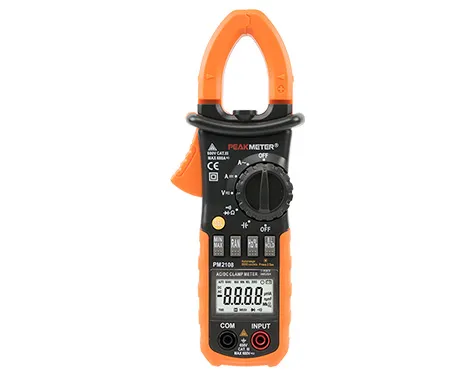
A clamp meter uses electromagnetic induction & Hall-effect sensors to read current without contact.
Clamp around a single live wire – no disconnection, no power-off needed.
Safely measures high-current loads up to 1000A.
Most PEAKMETER clamp meters also include full Digital Multimeter probe functions.
When to Use a PEAKMETER Digital Multimeter
Precision electronic repair (PCB, appliances, devices)
4–20mA industrial loop calibration
Low-current circuit testing
Capacitance, diode, and resistance measurement
Educational training and lab use
When to Use a PEAKMETER Clamp Meter
Live industrial motor & compressor current testing
Solar PV system DC/AC load measurement
HVAC runtime current and inrush detection
Distribution panel three-phase balance checks
Fast on-site troubleshooting without shutdown
Choose a Digital multimeter for precision, electronics, and low-current work.
Choose a clamp meter for speed, safety, and high-current field jobs.
Most professional technicians carry both for complete versatility.
PEAKMETER products meet CE, CAT III, CAT IV, and global safety standards for reliable performance worldwide.

 English