| Term | Explanation |
| General & Basic Terms |
| Multimeter | A test instrument used to measure multiple electrical quantities, typically voltage, current, and resistance. |
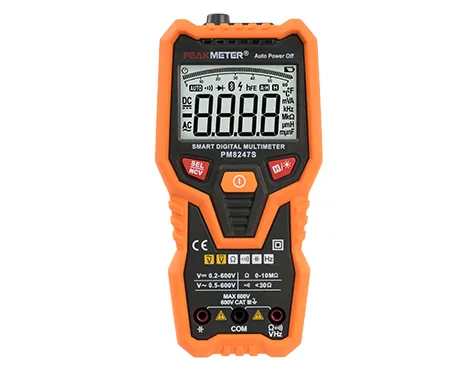
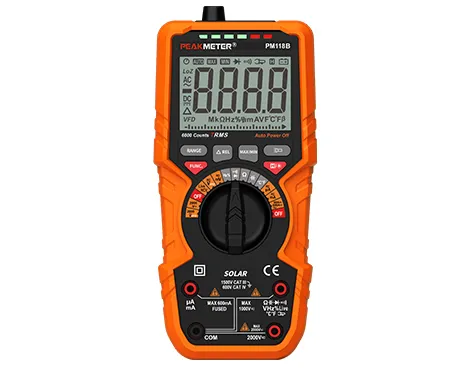
| Digital Multimeter (DMM) | A multimeter that displays measured electrical values digitally and often includes functions such as continuity, capacitance, and frequency testing. |
| Analog Multimeter | A multimeter that uses a moving needle and graduated scale to indicate measured electrical values. |
| Accuracy | The closeness of a measured value to the true or reference value, usually specified as a percentage plus counts or digits. |
| Resolution | The smallest change in a measured quantity that an instrument can display or distinguish. |
| Auto-ranging | A function that automatically selects the most suitable measurement range for the detected signal. |
| Manual-ranging | A measurement mode in which the user selects the desired range instead of letting the instrument choose automatically. |
| True RMS | A measurement method that calculates the effective value of AC signals accurately, including distorted or non-sinusoidal waveforms within the meter's limits. |
| RMS | Root mean square; the effective value of an AC voltage or current that produces the same heating effect as an equivalent DC value. |
| Calibration | The process of comparing an instrument with a known reference and adjusting or documenting its measurement performance. |
| Data Hold | A function that freezes the current reading on the display so it can be viewed after the probes are removed. |
| Max/Min Recording | A function that records and displays the highest and lowest values measured during a test period. |
| Relative Mode | A function that uses a stored reading as a reference and displays the difference between new measurements and that reference. |
| Overload Protection | Circuit protection designed to help prevent instrument damage when the input exceeds the rated measurement limit. |
| CAT Rating | A measurement category rating, such as CAT II, CAT III, or CAT IV, that indicates the transient overvoltage environment for which a test instrument is designed. |
| Probe | A conductive test accessory used to contact a circuit or component and carry the measurement signal to the instrument. |
| Test Leads | Insulated wires with probes or clips that connect a test instrument to the circuit or component being measured. |
| Backlight | Display illumination that improves readability in dark or low-light conditions. |
| Auto Power Off | A power-saving feature that automatically turns the instrument off after a period of inactivity. |
| Battery Indicator | A display symbol or status function that shows the remaining battery condition of the instrument. |
| Bluetooth Multimeter | A multimeter with Bluetooth connectivity for transferring readings to a phone, tablet, or other compatible device. |
| Smart Multimeter | A digital multimeter with automatic function recognition, connectivity, data logging, or other advanced measurement features. |
| IP Rating | An Ingress Protection rating that indicates the enclosure's resistance to solid objects and water, such as IP54 or IP67. |
| Safety Standard | A published set of technical requirements intended to ensure safe design, construction, and use of electrical equipment or test instruments. |
| Full Scale | The maximum value that can be indicated or measured on a selected instrument range. |
| Date Storage | A feature for saving measurement readings in instrument memory for later review; this term is commonly written as 'Data Storage'. |
| Electrical Safety Testers |
| Insulation Resistance | The resistance offered by insulating material to current leakage, commonly measured in megohms or gigohms. |
| Insulation Tester | An instrument that applies a specified DC test voltage and measures insulation resistance in cables, motors, appliances, or installations. |
| Megger | A commonly used name for an insulation resistance tester; the term originates from the Megger brand and is often used generically. |
| Earth Resistance | The resistance between an earthing system and the surrounding soil or reference earth. |
| Earth Tester | An instrument used to measure earth electrode resistance, grounding system performance, or related ground parameters. |
| Grounding | The intentional connection of exposed conductive parts or electrical systems to earth for safety, reference, or fault-current control. |
| Ground Bond Test | A high-current, low-resistance test used to verify the integrity of the protective earth connection in electrical equipment. |
| Phase Sequence | The order in which the phase voltages of a multiphase AC system reach their positive peaks. |
| Phase Rotation Indicator | A tester used to identify the phase sequence or rotational order of a three-phase electrical supply. |
| Voltage Detector | A device used to determine whether electrical voltage is present at a conductor, outlet, or circuit point. |
| NCV (Non-Contact Voltage) | A function that detects the presence of AC voltage through an electric field without direct metal-to-metal contact. |
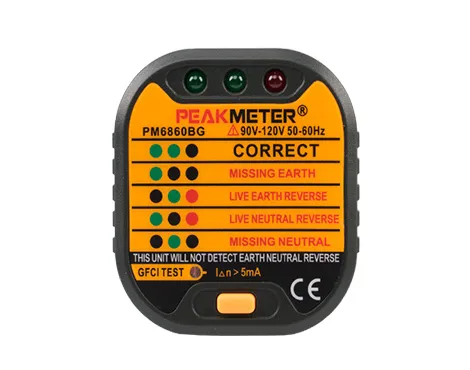
| Socket Tester | A plug-in tester that checks common outlet wiring conditions and, on some models, protective-device operation. |
| RCD Tester | An instrument that tests residual current devices by applying controlled leakage current and measuring trip time or trip current. |
| Hipot Tester | A high-potential tester that applies a high voltage to verify dielectric strength and electrical insulation safety. |
| Leakage Current Tester | An instrument used to measure small unintended currents flowing from live circuits through insulation, ground, or accessible parts. |
| Polarization Index (PI) | A diagnostic ratio of insulation resistance measured at a later time to an earlier time, commonly used to assess insulation condition. |
| Dielectric Absorption Ratio (DAR) | A ratio of insulation resistance readings taken at two different times to evaluate dielectric absorption and insulation quality. |
| Test Voltage | The specified voltage applied to a device or circuit during a test procedure. |
| Short Circuit | An unintended or deliberate very low-resistance connection between points of different potential that can cause excessive current. |
| High Voltage | A voltage level high enough to require special insulation, protection, or safety precautions; the exact threshold depends on the applicable standard. |
| Low Voltage | A lower electrical voltage classification whose exact limits depend on the applicable standard, installation type, and jurisdiction. |
| Continuity | The condition in which an electrically conductive path exists between two points with sufficiently low resistance. |
| Loop Resistance | The total resistance of a complete current path or loop, often measured to evaluate protective conductors, grounding paths, or high-current connections. |
| Cable Tester | An instrument used to check cable continuity, wiring order, faults, insulation, or other cable characteristics depending on the tester type. |
| Battery Tester | An instrument used to assess battery voltage, internal resistance, state of charge, capacity, conductance, or starting performance depending on the model. |
| Transistor Tester | An instrument used to identify transistor type, pin configuration, gain, junction condition, or related semiconductor parameters. |
| Measurement Tools |
| Measurement Tool | A device or instrument used to quantify a physical, electrical, mechanical, or environmental property. |
| Laser Distance Meter | A handheld instrument that uses a laser to measure distance by analyzing the reflected signal. |
| Laser Level | A leveling instrument that projects a laser line or point to establish horizontal, vertical, or alignment references. |
| Tachometer | An instrument used to measure rotational speed, typically in revolutions per minute (RPM). |
| Wood Moisture Meter | An instrument designed to estimate the moisture content of wood using pin-type, pinless, or other sensing methods. |
| Moisture Meter | An instrument used to estimate moisture content in materials such as wood, building materials, grain, or soil, depending on the model. |
| LCR Meter | An instrument used to measure inductance (L), capacitance (C), and resistance (R), often at selectable test frequencies. |
| Transistor Tester | An instrument used to identify transistor type, pin configuration, gain, junction condition, or related semiconductor parameters. |
| Component Tester | An instrument used to identify and evaluate electronic components such as resistors, capacitors, diodes, transistors, and related devices. |
| Socket Tester | A plug-in tester that checks common outlet wiring conditions and, on some models, protective-device operation. |
| Cable Tester | An instrument used to check cable continuity, wiring order, faults, insulation, or other cable characteristics depending on the tester type. |
| Wire Tracker | A transmitter-and-receiver tool used to trace wires or cables through bundles, walls, or installations. |
| Network Cable Tester | An instrument used to verify network cable continuity, pair order, opens, shorts, split pairs, or performance depending on the model. |
| Battery Tester | An instrument used to assess battery voltage, internal resistance, state of charge, capacity, conductance, or starting performance depending on the model. |
| Angle Finder | A tool used to measure or transfer angles, slope, or inclination. |
| Digital Level | An electronic leveling tool that displays angle, slope, or level information numerically. |
| Stud Finder | A handheld detector used to locate framing studs or, on some models, metal, live wires, or other objects behind surfaces. |
| Thickness Gauge | An instrument used to measure material, coating, wall, or layer thickness using an appropriate sensing method. |
| Vibration Meter | An instrument used to measure vibration parameters such as acceleration, velocity, or displacement in machinery and structures. |
| Light Level Meter | An instrument used to measure ambient light or illuminance, typically in lux or foot-candles. |
| Distance Meter | An instrument used to measure the distance between two points using laser, ultrasonic, optical, or other sensing methods. |
| Range Finder | A device used to determine the distance from the observer to a target, commonly using laser or optical methods. |
| Laser Pointer | A handheld device that emits a narrow visible laser beam for pointing, alignment, or reference purposes. |
| Digital Multimeter Terms |
| Voltage | The electrical potential difference between two points, measured in volts (V). |
| Current | The rate of electric charge flow through a conductor, measured in amperes (A). |
| Resistance | The opposition to electric current flow in a material or circuit, measured in ohms (Ω). |
| Capacitance | The ability of a component or system to store electric charge, measured in farads (F). |
| Frequency | The number of repeating cycles of a periodic signal per second, measured in hertz (Hz). |
| Duty Cycle | The percentage of one signal period during which a pulse or waveform is in its active or high state. |
| Diode Test | A multimeter function that applies a small test current to a diode and displays its forward voltage drop. |
| Continuity Test | A test that checks whether a low-resistance electrical path exists, often indicated by an audible beep. |
| AC (Alternating Current) | Electric current that changes direction periodically, typically following a repeating waveform. |
| DC (Direct Current) | Electric current that flows in one direction with constant or slowly varying polarity. |
| Ohm's Law | The relationship among voltage, current, and resistance, expressed as V = I × R. |
| Impedance | The total opposition a circuit presents to alternating current, combining resistance and reactance. |
| Inductance | The property of a conductor or coil that opposes changes in current by storing energy in a magnetic field, measured in henries (H). |
| Temperature Measurement | The measurement of temperature using a compatible sensor, probe, thermocouple, or built-in sensing function. |
| Peak Value | The maximum instantaneous magnitude reached by a waveform during a measurement interval. |
| Average Value | The arithmetic mean of measured values or waveform samples over a defined period. |
| Crest Factor | The ratio of a waveform's peak value to its RMS value, used to describe how sharply peaked the waveform is. |
| Bandwidth | The range of signal frequencies over which an instrument can measure within its specified performance limits. |
| Input Impedance | The impedance presented by a measuring instrument to the circuit under test, which affects how much the instrument loads the circuit. |
| Burden Voltage | The voltage drop introduced by a current-measuring instrument because of its internal resistance or shunt. |
| Open Circuit Voltage | The voltage measured across two terminals when no load is connected and essentially no current is flowing. |
| Short Circuit Current | The current that flows when two points are connected by a very low-resistance path. |
| Fuse | A replaceable overcurrent protection device that opens the circuit when current exceeds its rated limit. |
| Buzzer | An audible sounder used by a test instrument to indicate conditions such as continuity, warnings, or key operation. |
| EVSE & New Energy |
| EVSE | Electric Vehicle Supply Equipment; equipment that safely supplies electrical energy from the power source to an electric vehicle for charging. |
| EVSE Adaptor | An adapter used to connect EV charging equipment and a vehicle when their connector formats or interfaces differ and compatibility is supported. |
| Type 2 EVSE | EV charging equipment using the IEC Type 2 interface, widely used for AC charging in Europe and other markets. |
| SAE J1772 | A North American standard defining a conductive EV charging interface commonly associated with the Type 1 AC connector. |
| Tesla NACS | The North American Charging Standard connector system used for AC and DC fast charging on compatible electric vehicles. |
| Charging Station | An installation that provides one or more EV charging points, together with the necessary electrical, control, communication, and protection equipment. |
| Photovoltaic (PV) | Technology that converts sunlight directly into electrical energy using semiconductor solar cells. |
| Solar Inverter | A power-electronic device that converts DC electricity from solar panels into usable AC electricity and may also provide grid-control functions. |
| Grid-Tied | Describes an electrical or renewable-energy system connected to and operating in coordination with the utility grid. |
| Off-Grid | Describes an electrical or renewable-energy system that operates independently of the utility grid, often using batteries or local generation. |
| Insulation Monitoring | Continuous or periodic supervision of insulation resistance to detect deterioration or ground faults in an electrical system. |
| Residual Current | The difference between the currents flowing in the live conductors of a circuit, which can indicate leakage to earth or another unintended path. |
| Charging Time | The time required to charge an electric vehicle or battery from one state of charge to another under specified conditions. |
| Charging Power | The rate at which electrical energy is delivered during charging, typically expressed in kilowatts (kW). |
| Voltage Compatibility | The ability of equipment to operate safely and correctly with the voltage level or voltage range provided by another device or system. |
| CP Signal | Control Pilot signal; the EV charging control signal used to coordinate connection status, charging permission, and available current between EVSE and vehicle. |
| PP Signal | Proximity Pilot signal; a signal used in supported EV charging interfaces to detect connector or cable presence and convey cable-related information. |
| Electric Vehicle | A vehicle propelled partly or entirely by one or more electric motors using electrical energy stored or supplied onboard. |
| Charging Pile | A term commonly used for an EV charge point or charging unit that supplies electrical energy to an electric vehicle. |
| New Energy Testing | Testing of equipment and systems used in technologies such as electric vehicles, charging infrastructure, solar power, batteries, and related power electronics. |
| Environmental Testers |
| Environmental Tester | A general-purpose instrument used to measure environmental conditions such as temperature, humidity, light, sound, air quality, gas concentration, or airflow. |
| Lux Meter | An instrument that measures illuminance, typically in lux (lx). |
| Sound Level Meter | An instrument that measures sound pressure level, typically expressed in decibels (dB). |
| Anemometer | An instrument used to measure air velocity or wind speed and, on some models, airflow volume. |
| Temperature & Humidity Meter | An instrument that measures ambient temperature and relative humidity, often with additional calculated comfort parameters. |
| Infrared Thermometer | A non-contact thermometer that estimates surface temperature from emitted infrared radiation. |
| Digital Probe Thermometer | A thermometer that uses a contact probe or sensor to measure temperature and displays the result digitally. |
| Gas Detector | An instrument used to detect or measure the presence and concentration of one or more gases. |
| Combustible Gas Detector | A detector used to identify flammable or combustible gases and warn when concentrations approach unsafe levels. |
| Toxic Gas Detector | A detector used to measure hazardous toxic gases and provide an alarm when concentrations exceed defined limits. |
| Illuminance | The amount of luminous flux falling on a surface per unit area, measured in lux (lx). |
| Decibel (dB) | A logarithmic unit used to express ratios, commonly used for sound level and signal level measurements. |
| Dew Point | The temperature at which air becomes saturated with water vapor and condensation begins. |
| Wet Bulb Temperature | The temperature indicated by a wetted, ventilated sensor and used with dry-bulb temperature to evaluate humidity and heat stress. |
| Relative Humidity | The amount of water vapor in air expressed as a percentage of the maximum amount the air could hold at the same temperature. |
| Air Quality | A description or measurement of the cleanliness and health-related condition of air based on pollutants, gases, particles, and other factors. |
| CO2 Detector | An instrument used to detect or measure carbon dioxide concentration in air, commonly reported in parts per million (ppm). |
| Light Meter | An instrument used to measure light level, usually as illuminance in lux or foot-candles. |
| UV Meter | An instrument used to measure ultraviolet radiation intensity or exposure in a specified UV wavelength range. |
| Wind Speed | The rate of air movement relative to a fixed point, commonly measured in m/s, km/h, mph, or knots. |
| Wind Chill | A calculated index describing how cold conditions feel on exposed skin due to the combined effects of air temperature and wind. |
| Heat Index | A calculated index describing how hot conditions feel based mainly on air temperature and relative humidity. |
| Particulate Matter (PM2.5/PM10) | Airborne particles with aerodynamic diameters generally up to 2.5 µm or 10 µm, commonly monitored as indicators of air pollution. |
| Formaldehyde Detector | An instrument used to detect or measure formaldehyde concentration in indoor or industrial air. |
| Electromagnetic Field (EMF) Meter | An instrument used to measure electric fields, magnetic fields, or electromagnetic field strength over a specified frequency range. |
| Clamp Meter Terms |
| Clamp Meter | A handheld meter that measures current by clamping around a conductor, usually without disconnecting the circuit. |
| AC Clamp Meter | A clamp meter designed primarily to measure alternating current through a conductor. |
| AC/DC Clamp Meter | A clamp meter capable of measuring both alternating current and direct current. |
| Flex Clamp | A flexible current-measuring probe or clamp that can wrap around large or tightly packed conductors. |
| Current Clamp | A clamp-type current sensor that detects current around a conductor and provides a signal to a meter or test instrument. |
| Inrush Current | The brief, high current drawn when electrical equipment such as motors, transformers, or power supplies is first energized. |
| Leakage Current | Unintended current that flows through insulation, protective conductors, ground paths, or other normally non-current-carrying paths. |
| Harmonics | Voltage or current components whose frequencies are integer multiples of the fundamental frequency and can distort an AC waveform. |
| Power Factor | The ratio of active power to apparent power in an AC circuit, indicating how effectively electrical power is being used. |
| Active Power | The real power that performs useful work in an AC circuit, measured in watts (W). |
| Reactive Power | The power exchanged with inductive or capacitive elements in an AC circuit, measured in volt-amperes reactive (var). |
| Apparent Power | The product of RMS voltage and RMS current in an AC circuit, measured in volt-amperes (VA). |
| Jaw Opening | The maximum physical opening of a clamp meter jaw and therefore a key limit on conductor size. |
| True RMS Clamp Meter | A clamp meter that uses true RMS measurement to accurately measure AC current on both sinusoidal and distorted waveforms within its specifications. |
| Flexible Current Probe | A flexible sensor, often based on a Rogowski coil, used to measure AC current around large or difficult-to-access conductors. |
| Rogowski Coil | An air-core flexible coil that measures alternating current by sensing the changing magnetic field around a conductor. |
| Current Range | The minimum-to-maximum current span an instrument can measure on a selected or available range. |
| Voltage Measurement | The process of measuring electrical potential difference between two points in a circuit. |
| Frequency Measurement | The process of measuring the repetition rate of an electrical signal in hertz. |
| Non-Contact Measurement | A measurement method that senses a quantity without making direct electrical or physical contact with the target. |
| Clamp Size | The physical dimensions or opening capacity of a clamp meter jaw or flexible clamp sensor. |
| Safety Jaw | An insulated clamp-jaw design intended to reduce accidental contact with live conductors and improve safe handling. |


 English