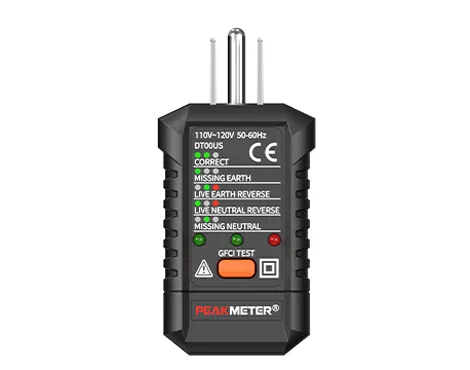

1.Calibrated Measurement Accuracy for Industrial‑Grade Readings
Pokcenser circuit testers are factory‑calibrated to deliver stable measurement precision for industrial circuits. Optimised sampling algorithms minimise reading deviations on voltage, continuity and fault checks. It delivers trustworthy data for routine maintenance and circuit troubleshooting in factory power systems.
2.Strong EMC Anti‑Interference for Noisy Industrial Sites
Built‑in EMC shielding suppresses electromagnetic noise from motors and heavy‑duty equipment. It avoids distorted readings caused by field interference common in industrial workshops. Reliable outputs ensure accurate diagnosis even in complex high‑noise electrical environments.
3.Long‑Term Stability & Built‑in Self‑Diagnosis Function
Self‑diagnosis checks internal circuit status before testing to flag low‑battery or hardware abnormalities. Strict component selection reduces accuracy drift over time. Consistent performance supports long‑hour on‑site inspection, lowering misjudgement risks for industrial electrical maintenance.
1. Complete Pre‑use Inspection and Safety Preparation Before Every Circuit‑Checking Job
You need to examine the outer casing, sensor probe and indicator lights of your Pokcenser non‑contact circuit tester for cracks, wear‑and‑tear or water damage before startup. Run a quick detection test on a confirmed live AC wall‑outlet to verify audible beep and LED warning functions work normally. Keep your hands fully dry, remove metal‑made wrist accessories and stay away from wet, damp working surroundings to cut down electric‑shock risks throughout circuit diagnosis. Never operate the tester once its insulating shell gets broken or the low‑power alert keeps flashing.
2. Master Standard Detecting Procedures for Live‑wire Confirmation and Hidden‑fault Troubleshooting
Switch the sensitivity gear according to onsite conditions, hold the insulated plastic grip and move the induction probe close yet without direct contact with insulated cables, distribution‑box terminals, wall sockets and concealed wiring routes. Move the tester slowly along wire layouts; intensified beep frequency and bright flashing lights mark the position of energized live conductors. You can also trace buried‑wire breakpoints by observing where the voltage‑triggered warning disappears, which helps you locate broken underground or wall‑embedded circuits without demolishing wall surfaces.
3. Carry Out Power‑off Validation and Multi‑point Detection to Prevent Misjudgement
After you turn off the corresponding circuit breaker for maintenance work, scan every terminal, branch wire and socket contact with the Pokcenser circuit tester to double‑check residual induced‑voltage. Interfering electromagnetic signals from nearby heavy‑duty machinery may trigger false alerts, so switch between high‑sensitivity and low‑sensitivity modes to filter out irrelevant electric‑field disturbance. Do not begin wire‑removal or component maintenance work until repeated multi‑spot testing delivers zero live‑voltage warning feedback on your target circuit.
4. Follow Scenario‑based Tips and Post‑operation Maintenance for Long‑term Safe Service
For household socket inspection, residential light‑circuit overhaul and EV charging‑port safety screening, choose low‑sensitivity mode for precise nearby‑wire recognition. When you inspect dense wiring inside industrial control cabinets and photovoltaic combiner boxes, activate high‑sensitivity settings to pick up weak electric‑field signals from tightly‑arranged cables. Switch off the tester after‑use, wipe dust and moisture from the sensing tip, and store the handheld tester inside your dry tool kit. Avoid long‑time exposure under high‑temperature outdoor sunshine so the induction sensor maintains stable detecting performance for all‑day circuit diagnosis.
5. Understand Functional Limits and Match Supplementary Testing Tools for Complex‑circuit Tasks
Bear in mind the Pokcenser non‑contact circuit tester only senses alternating‑current electric‑field signals and cannot deliver exact voltage numerical‑readings. When you diagnose mixed AC‑DC control loops or high‑frequency variable‑frequency drive wiring, combine this induction tester with a professional multimeter for contact‑type voltage measurement. Keep strictly within the rated 12V‑1000V AC testing range and never apply the detector on ultra‑high‑voltage industrial facilities beyond its official safety specification.


 English